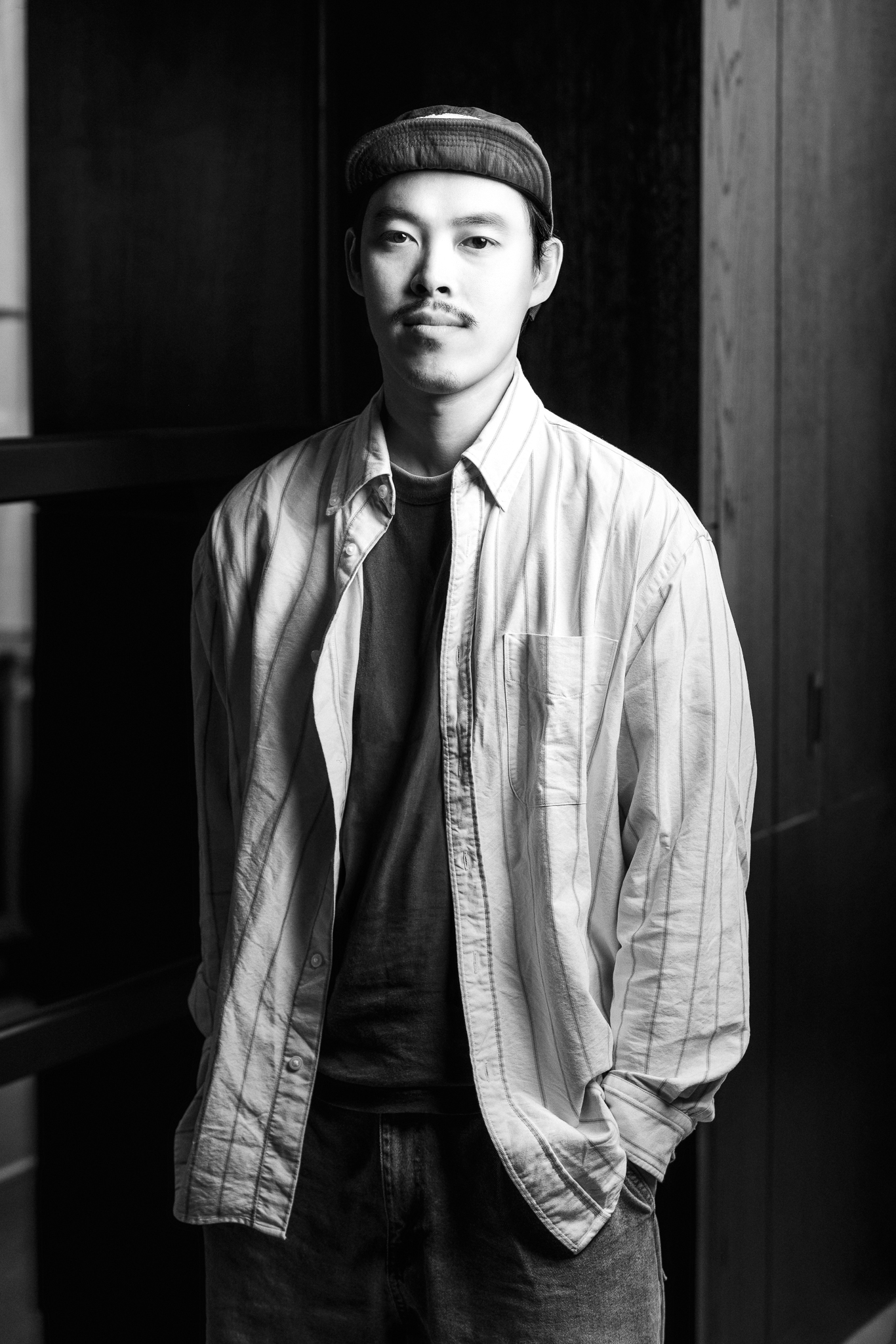
My practice originates from my engagement with materials and tools in the process of making. The sounds in my work emerge from labor and its environment — the plucking of guitar strings, the crack of stone struck apart, the pulse of a nail gun fastening wood. These sounds form the formal foundation of my sculptural practice; I capture what arises naturally in these processes and transform it into works.
I approach architecture not as an architect but as a worker who has built it. Trained and still working as a carpenter, I understand a building less through its completed form than through the labor that brings it into being. The materials I return to — weatherboard, Minnan roof tile, corrugated metal — are ones Taiwan and Malaysia share, arriving as colonial technology or produced under colonial policy. What draws me is their construction: each piece laid partly over the last so water runs off, not in. This overlapping follows the logic of layered sound. Drainage and sound share a structure, where building becomes sculpture for me.
I extend sculpture's "visuality" and "materiality" into the auditory realm of "sound," so that reception begins with listening before expanding into the tactile and visual, reversing our habitual mode of encountering sculpture. Through sound I give form to the "temporality of sculpture," a response to my own condition of labor. I preserve sound within the finished work, so viewers may sense the traces of labor condensed within each piece.
Ongoing / Upcoming
- 2026Rain House (雨淋屋), Solo Exhibition, TMY Foundation, Yongkang St., Taipei (Oct 31–Nov 29)
- 2026Falling Rain (落水), 2026 Taipei Art Award Finalist Exhibition (dedicated gallery room), Taipei Fine Arts Museum, Taipei (Oct 24, 2026–Feb 14, 2027)
Solo Exhibitions
- 2020Stone. Motor 000 — Solo Exhibition, King Car Cultural & Art Center, Taipei
- 2018A Decadent Life, Yongfu No. 5, New Taipei
- 2017Carpe Diem, Nan Bei Gallery, Taipei
Group Exhibitions
- 2026Tin Roof Rain Fall 2.0 (Tainan), Tainan New Art Award "Windy Hills: Brewers of Civilization", Mizuiro Workshop, Tainan
- 2026Swab Art Fair Barcelona, Barcelona
- 2026Moonlit Woods: Resonance of Lights, Chiayi City
- 2025Rain Series II, Hualien Art Museum
- 2024Rebirth Tomorrow: Sustainability, Environment, Imagination, Hsinchu Railway Art Village
- 2023Between Inside/Outside — Sculpture Workshop Exhibition, Nan Bei Gallery, TNUA, Taipei
- 2020Field: Six-Person Joint Exhibition, TNUA graduation off-campus show, Air Force Sanchong Village No. 1, New Taipei
- 20192nd Lihpao Contemporary Sculpture, TNUA Underground Art Museum, Taipei
- 2019BMS Young Contemporaries Open+Lab, National Art Gallery BMS, Kuala Lumpur
- 2019Excellence Award for Art Creators — Seeing Urban Space, Kuandu Museum of Fine Arts, Taipei
Awards
- 2026Tainan New Art Award
- 2026Nanying Award, Space and Mixed Media — Merit Award, Rain House Alley (雨淋屋巷)
- 20246th Lihpao Contemporary Sculpture Award — First Prize
- 2024Hualien Hui-Lan Award — Shortlisted
- 20192nd Lihpao Contemporary Sculpture — Honorable Mention
- 2019Excellence Award for Art Creators — Seeing Urban Space, Kuandu Museum of Fine Arts
我的創作源於製作過程中對材料與工具的思考。作品中的聲音來自勞動及其所處的環境——撥動吉他弦的聲響、石塊被敲擊至碎裂的聲音、釘槍釘製木作的節奏。這些聲音成為我雕塑創作的形式基礎;我捕捉在這些過程中自然產生的聲響,並將它們轉化為作品。
我以工人而非建築師的視角面對建築。我受過木工訓練,至今仍以此為業,因此我理解一棟建築,靠的不是它完成後的形式,而是讓它成形的勞動。我反覆回到的材料——雨淋板、閩南瓦、鐵皮浪板——是台灣與馬來西亞共有的,它們或作為殖民技術傳入,或是殖民政策下的產物。吸引我的是它們的構造方式:每一片都疊在前一片之上,讓水往外流,而不是往內滲。這種疊加,依循的正是聲音疊加的邏輯。排水與聲音共享一種結構,而建築正是在那裡成為我的雕塑。
我將雕塑的「視覺性」與「材料性」延伸至「聲音」的聽覺領域,使觀眾的接收從聽覺開始,再擴展到觸覺與視覺,反轉了我們習以為常的雕塑觀看方式。透過聲音,我賦予「雕塑的時間性」以形式,回應我自身的勞動狀態。我將聲音保留在作品的成品之中,使觀者得以感受到每一件作品裡所凝結的勞動痕跡。
正在發生中/即將展出
- 2026《雨淋屋》個展,天美基金會 永康街空間,臺北市(10/31–11/29)
- 2026《落水》,2026 臺北美術獎 決審聯展(獨立展間),臺北市立美術館,臺北市(10/24–2027/2/14)
個展
- 2020《石。馬達000 — 楊健生個展》,金車藝文中心,臺北市
- 2018《A Decadent Life》,永福5號,新北市
- 2017《及時行樂 Carpe Diem》,南北畫廊,臺北市
聯展
- 2026《鐵皮雨淋 2.0「臺南」》,臺南新藝獎「倒風內山:文明發酵術」聯展,水色藝術工坊,臺南市
- 2026Swab Art Fair Barcelona,巴塞羅那
- 2026森林夜遊,《建築皮層:屋瓦》,安和街陳宅,嘉義市
- 2025《雨淋 2.0》,花蓮美術館
- 2024《明日再生:永續.環境.想像》,新竹鐵道藝術村
- 2023《內/外之間》雕塑工作坊成果展,北藝大南北畫廊,臺北市
- 2020田田六人聯展,北藝大美術系畢業展校外展區,空軍三重一村,新北市
- 2019第二屆麗寶(立寶)當代雕塑,北藝大地下美術館,臺北市
- 2019BMS Young Contemporaries Open+Lab,吉隆坡國家美術館,馬來西亞
- 2019美術創作者卓越獎「看見城市空間」,國立關渡美術館,臺北市
得獎
- 2026臺南新藝獎 得獎藝術家
- 2026南瀛獎 空間與複合媒材類《雨淋屋巷》佳作
- 2024第六屆立寶當代雕塑獎 首獎
- 2024花蓮洄瀾獎 入選
- 2019第二屆麗寶(立寶)當代雕塑 優賞
- 2019美術創作者卓越獎「看見城市空間」優選,國立關渡美術館